
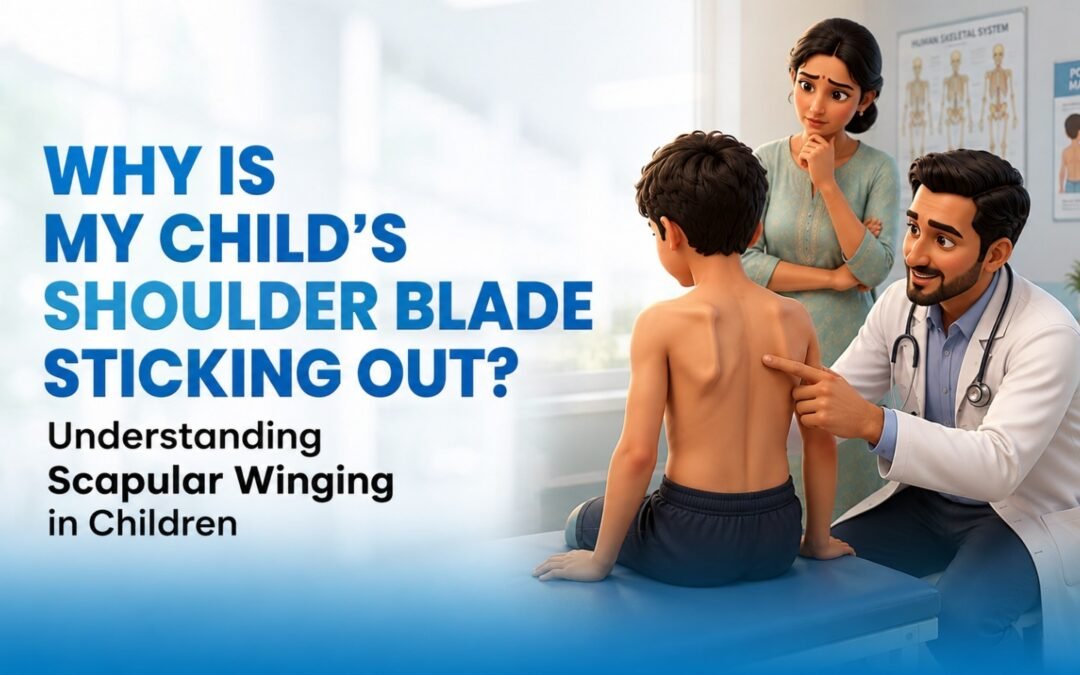
Have you noticed one of your child’s shoulder blades sticking out more than the other, especially when they push against a wall or lift their arms? It can look unusual, and naturally, the first thought is: “Is something wrong with my child’s shoulder?”
A prominent shoulder blade may simply be a difference in posture, but sometimes it can be scapular winging in children—a condition where the shoulder blade moves away from the chest wall instead of lying flat against it. The important part is understanding why it is happening
What Is Scapular Winging?
The shoulder blade, or scapula, normally rests against the back of the rib cage and moves smoothly as your child lifts and rotates their arm.
When the shoulder blade protrudes noticeably, it is called scapular winging.
It may become particularly obvious when your child:
- Pushes against a wall
- Raises their arms
- Pushes, pulls or lifts something
- Reaches overhead
Sometimes, it affects one shoulder. Sometimes, both sides may appear prominent.
Why Does a Child’s Shoulder Blade Stick Out?
There isn’t always one reason.
1. Muscle weakness
The muscles around the shoulder blade help keep it stable. If these muscles are weak or not functioning properly, the scapula may become more prominent.
One important muscle is the serratus anterior, which helps hold the shoulder blade against the rib cage.
2. Nerve-related problems
The muscles responsible for shoulder blade movement depend on healthy nerve function. In some children, nerve injury or nerve dysfunction can affect these muscles and lead to scapular winging.
This is one reason a proper clinical examination matters.
3. Previous injury
A fall, sports injury or trauma around the shoulder may sometimes affect the muscles, nerves or joints involved in normal scapular movement.
Interestingly, children may not always remember a specific injury.
4. Posture and muscle imbalance
Sometimes, what looks like scapular winging is related to posture, shoulder mechanics or muscle imbalance rather than a serious underlying problem.
Growing children constantly change the way they stand, sit and move, so their posture can change too.
Is Scapular Winging Painful?
Not always.
Some children have scapular winging without pain and may only notice that one shoulder blade looks different.
Others may experience:
- Shoulder pain
- Weakness
- Difficulty lifting the arm
- Reduced shoulder movement
- Fatigue during sports
- Difficulty with pushing or pulling activities
If your child is struggling to use the arm normally, don’t ignore it simply because there is no obvious injury.
How Is Scapular Winging Diagnosed?
The good news is that diagnosis often starts with something very simple: watching your child move.
A pediatric orthopedic specialist may assess your child’s posture, shoulder movement, muscle strength and symmetry. They may ask the child to raise their arms or push against a wall to observe how the shoulder blade behaves.
Depending on the findings, additional tests may be recommended to evaluate the nerves, muscles or bones.
The aim isn’t simply to confirm that the shoulder blade is prominent. It is to understand why it is prominent.
Does Scapular Winging Need Treatment?
Not every child needs treatment.
If the winging is mild and there is no significant weakness or functional problem, observation may sometimes be appropriate.
When muscle weakness or movement problems are identified, physiotherapy for scapular winging may help improve shoulder strength, movement and control. Exercises are usually selected according to the underlying cause rather than simply trying to “push the shoulder blade back.”
If there is a significant nerve, muscle or structural problem, treatment will depend on the specific diagnosis.
When Should You See a Doctor?
Consider getting your child evaluated if:
- One shoulder blade suddenly starts sticking out
- The difference is becoming more noticeable
- Your child has shoulder pain or weakness
- They cannot raise the arm normally
- Sports or everyday activities have become difficult
- There is a history of trauma
- The shoulder blade is associated with other unusual movements or weakness
A prominent shoulder blade in a child isn’t automatically a serious condition—but a new or progressive change deserves attention.
Final Thoughts
Children’s bodies are constantly growing and changing, so an uneven shoulder blade doesn’t necessarily mean something is wrong.
But if your child’s shoulder blade sticks out noticeably, especially on one side or along with pain, weakness or difficulty moving the arm, it’s worth finding out why.
Sometimes the answer is posture. Sometimes it is muscle imbalance. Occasionally, a nerve or structural issue may be involved.
The key is not to judge the condition by appearance alone.
A shoulder blade that looks different is a clue-not a diagnosis.
A proper pediatric orthopedic evaluation can help identify the cause and determine whether your child needs reassurance, monitoring, physiotherapy or further treatment.