
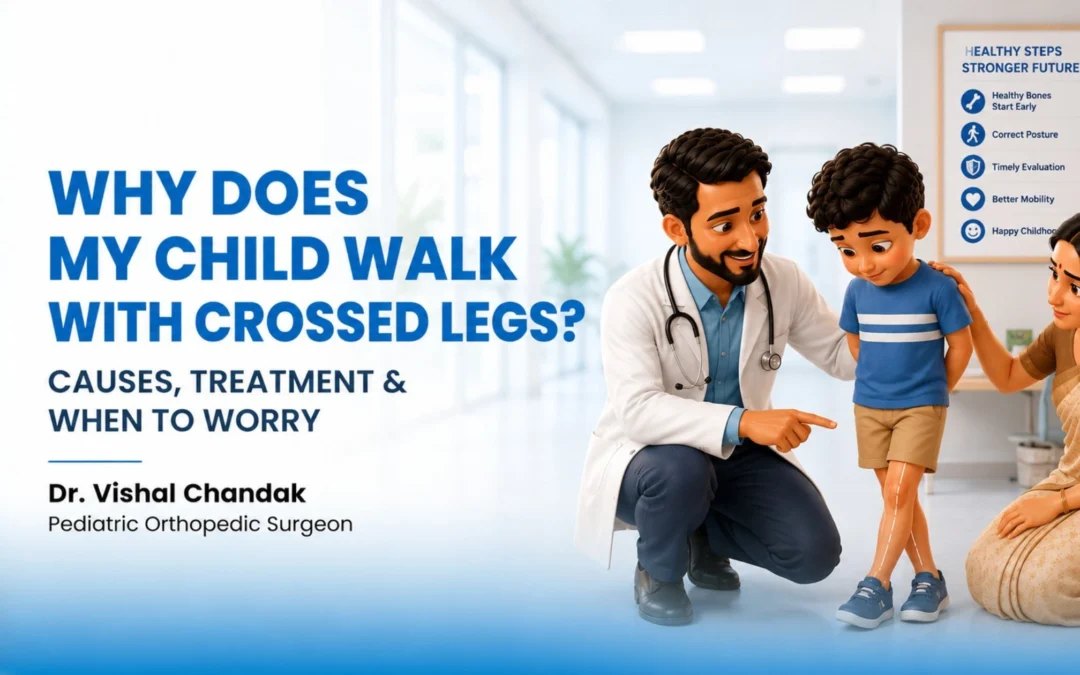
Many parents first notice it while watching their child walk across a room.
Instead of walking with their feet pointing straight ahead, the legs seem to cross over one another. Some children appear clumsy, trip frequently, or have a walking pattern that looks unusual compared to other children their age.
Naturally, parents begin asking questions:
“Why does my child walk with crossed legs?”
“Will it improve with growth?”
“Does my child need treatment?”
“Could this affect sports, posture, or bone development?”
Walking with crossed legs is a common reason for referral to a pediatric orthopedic surgeon. In many children, it is related to normal developmental variations that improve naturally over time. However, in some cases, it may indicate an underlying orthopedic or neurological condition that requires evaluation.
Understanding the possible causes can help parents know when observation is appropriate and when medical attention is necessary.
What Does Walking with Crossed Legs Mean?
Walking with crossed legs typically refers to a gait pattern where the knees or legs move toward or across the body’s midline while walking.
Parents may notice:
- Knees brushing against each other
- Feet turning inward
- Legs appearing to cross while walking
- Frequent tripping
- An unusual walking pattern
- Difficulty running smoothly
The appearance can vary from mild to more noticeable depending on the underlying cause.
Is It Normal for Children to Walk This Way?
In many young children, certain walking variations are a normal part of growth and development.
As bones grow and alignment changes, children may temporarily exhibit:
- In-toeing (pigeon-toed walking)
- Knock knees
- Rotational differences in the legs
- Mild gait variations
Many of these developmental patterns improve naturally without treatment.
However, persistent or severe crossing of the legs should be assessed by a pediatric orthopedic specialist.
Common Causes of Crossed-Leg Walking in Children
Several conditions can contribute to this walking pattern.
In-Toeing (Pigeon-Toed Walking)
One of the most common causes is in-toeing.
Children with in-toeing walk with their feet turned inward rather than straight ahead. This may result from:
- Femoral anteversion (inward twisting of the thigh bone)
- Internal tibial torsion (inward twisting of the shin bone)
- Metatarsus adductus (curving of the foot)
In many cases, these conditions improve as a child grows.
Femoral Anteversion
Femoral anteversion is a common cause of crossed-leg walking in children. In this condition, the thigh bone rotates inward more than usual.
Children may:
- Sit in a “W” position
- Walk with feet pointing inward
- Appear to cross their legs while walking
- Trip more frequently
The condition is often most noticeable between 3 and 8 years of age.
Most children experience gradual improvement during growth.
Knock Knees (Genu Valgum)
Knock knees occur when the knees angle inward and touch while standing.
Children with significant knock knees may appear to walk with crossed legs because the knees move toward the body’s centerline during movement.
Mild knock knees are often a normal developmental stage between ages 3 and 5 years. Persistent or severe cases may require evaluation.
Internal Tibial Torsion
Internal tibial torsion occurs when the shin bone rotates inward.
This can make the feet turn inward while walking.
It is particularly common in toddlers and often improves naturally during early childhood.
Can Neurological Conditions Cause Crossed-Leg Walking?
Yes.
Although less common, certain neurological disorders may contribute to a crossed-leg gait. These may include:
- Cerebral palsy
- Muscle tone disorders
- Neuromuscular conditions
- Developmental neurological disorders
Children with neurological causes often have additional symptoms such as:
- Muscle stiffness
- Delayed developmental milestones
- Balance difficulties
- Weakness
- Abnormal muscle tone
These children benefit from early specialist assessment.
When Should Parents Be Concerned?
While many gait variations are harmless, some signs warrant further evaluation.
Frequent Tripping or Falling
Occasional falls are normal in young children.
However, persistent tripping may indicate an underlying issue affecting walking mechanics.
Progressive Worsening
A walking pattern that becomes more noticeable over time deserves attention.
Pain During Walking
Pain is not typically associated with normal developmental gait variations.
One-Sided Symptoms
If one leg appears significantly different from the other, further assessment is recommended.
Delayed Motor Development
Children who are delayed in walking, running, or other motor milestones should be evaluated. Muscle Stiffness
Tight muscles or difficulty moving joints normally should not be ignored.
Family Concern
Parents often notice subtle changes before anyone else.
If something about your child’s walking seems unusual, seeking advice is reasonable.
How Is Crossed-Leg Walking Evaluated?
A pediatric orthopedic evaluation typically includes:
Medical History
The specialist may ask about:
- Pregnancy history
- Birth history
- Developmental milestones
- Family history
- Duration of symptoms
Physical Examination
Assessment often includes:
- Walking pattern
- Leg alignment
- Hip motion
- Muscle strength
- Balance
- Joint flexibility
Imaging Studies
When necessary, investigations may include:
- X-rays
- Gait analysis
- Advanced imaging in selected cases
Many children do not require extensive testing.
Will My Child Outgrow It?
The answer depends on the cause.
Many children with:
- Femoral anteversion
- Internal tibial torsion
- Mild developmental in-toeing
- Physiological knock knees
improve naturally with growth.
Parents are often reassured to learn that observation is frequently the most appropriate treatment.
Regular follow-up may be recommended to ensure expected improvement occurs.
Do Special Shoes or Braces Help?
This is one of the most common questions parents ask.
For most developmental gait variations, research has shown that:
- Corrective shoes are usually unnecessary
- Special footwear does not accelerate correction
- Braces are often not required
Management depends on the underlying diagnosis rather than the appearance alone. A pediatric orthopedic specialist can guide families regarding the most appropriate approach.
When Is Physical Therapy Helpful?
Physical therapy may be beneficial in selected situations.
It can help improve:
- Balance
- Coordination
- Strength
- Functional mobility
- Movement patterns
Therapy is often particularly valuable when neurological or muscular factors contribute to gait abnormalities.
When Is Surgery Needed?
Surgery is rarely required for children with mild developmental gait variations. However, it may be considered when:
- Significant deformity persists
- Functional limitations develop
- Symptoms interfere with daily activities
- Underlying orthopedic conditions require correction
Surgical decisions are individualized based on the child’s age, symptoms, and diagnosis.
The Bottom Line
Walking with crossed legs can look concerning, but in many children it is related to normal developmental variations that improve naturally with growth.
Common causes include:
- Femoral anteversion
- In-toeing
- Internal tibial torsion
- Knock knees
Most children do not require aggressive treatment and can be managed through observation and regular follow-up.
However, persistent symptoms, worsening gait patterns, pain, developmental delays, or neurological signs should always be evaluated by a pediatric orthopedic specialist.
When it comes to your child’s growth and movement, timely assessment provides both peace of mind and the opportunity for early intervention when needed.