
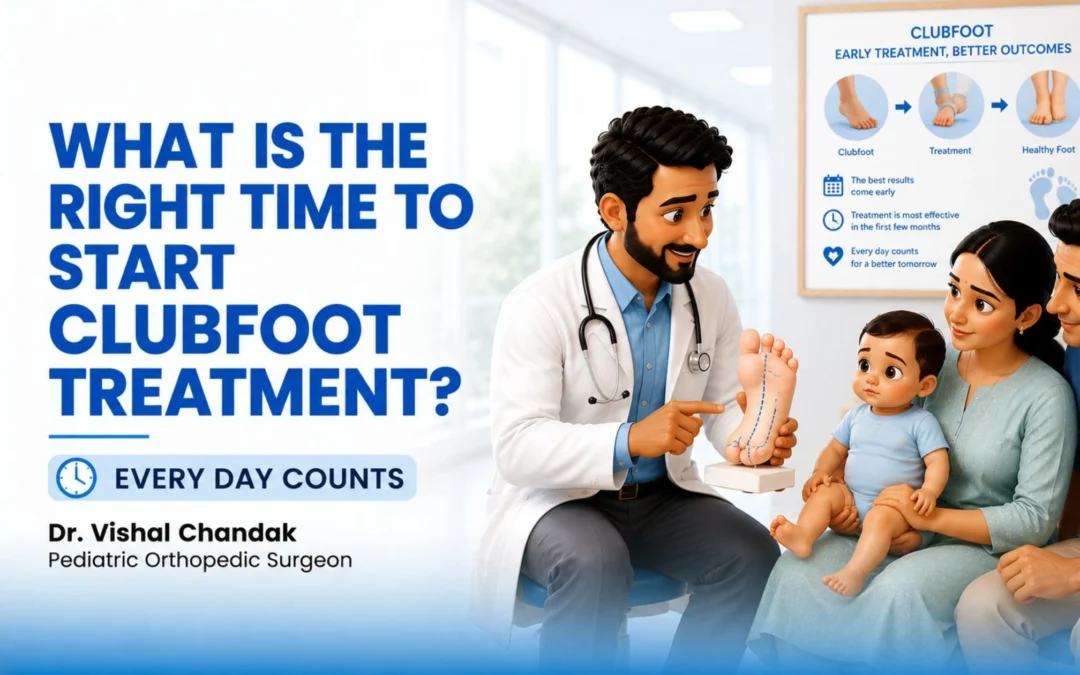
When parents hear the words “Your baby has clubfoot,” the first emotion is often fear. Questions start flooding in. Will my child walk normally? Is surgery necessary? Have we missed the right time?
Here’s the reassuring truth: clubfoot is one of the most successfully treatable birth conditions—provided treatment begins at the right time.
The timing of treatment plays a huge role in how simple, effective, and successful the correction will be. The earlier you begin, the better the outcome.
Let’s understand why.
What Is Clubfoot?
Clubfoot, medically known as Congenital Talipes Equinovarus (CTEV), is a condition where a baby’s foot is turned inward and downward at birth. It may affect one foot or both feet.
The bones, muscles, tendons, and ligaments are all present, but they are positioned differently. Without treatment, the child may eventually walk on the side or top of the foot instead of the sole.
The good news? Modern treatment can completely correct clubfoot in most children without major surgery.
So, When Is the Right Time to Start Clubfoot Treatment?
As Early As Possible—Ideally Within The First 1–2 Weeks After Birth This is considered the golden window for treatment.
A newborn’s bones, ligaments, and tendons are extremely soft and flexible. During these first few weeks, gentle correction is easier, faster, and more effective.
Starting treatment early means:
- Easier correction
- Fewer casts in many cases
- Better long-term foot function
- Lower chance of relapse
- Excellent cosmetic appearance
The earlier treatment begins, the easier it is to guide the foot into its normal position.
Can Treatment Start Immediately After Birth?
Yes.
If your baby’s overall health is stable, treatment can often begin within the first week of life. Parents don’t need to wait until the baby starts walking.
In fact, waiting is exactly what doctors advise against.
Why Early Treatment Makes Such A Big Difference
Think of a young tree.
When it’s small, you can gently guide its growth with minimal effort. Once it becomes thick and rigid, correcting its shape becomes much harder.
The same principle applies to clubfoot.
During infancy:
- Bones are softer.
- Tendons stretch more easily.
- Joints respond better to correction.
- The brain adapts quickly to normal movement patterns.
This is why pediatric orthopaedic surgeons encourage early intervention.
What Happens If Treatment Is Delayed?
Many parents delay treatment because they hope the foot will improve naturally. Unfortunately, clubfoot does not correct itself.
Without treatment, children may experience:
- Difficulty walking
- Pain while standing
- Calluses and skin problems
- Poor balance
- Limited participation in sports
- Emotional distress because of the visible deformity
The longer treatment is delayed, the stiffer the foot becomes.
Older children may require:
- More casts
- Longer treatment duration
- More extensive surgery
- Longer rehabilitation
The Ponseti Method: The Gold Standard
Today, the Ponseti Method is considered the world’s most successful treatment for clubfoot. It involves:
- Gentle Manipulation
The foot is carefully stretched into a slightly improved position.
- Weekly Casting
A plaster cast holds the corrected position.
Each week, the cast is changed, gradually improving the alignment.
Most babies require 5–8 casts.
- Minor Achilles Tendon Procedure
Around 80–90% of babies need a small outpatient procedure called an Achilles tenotomy to release a tight tendon.
This is quick, safe, and performed under local anesthesia in most infants. 4. Bracing
Once correction is achieved, special braces help maintain it.
This stage is just as important as the casting itself.
Is It Too Late If My Baby Is A Few Months Old?
Not necessarily.
Although earlier is better, treatment can still be successful even if started later. Babies who begin treatment at:
- 2 months
- 4 months
- 6 months
can still achieve excellent results using the Ponseti Method.
However, correction may take slightly longer.
What About Older Children?
Even toddlers and older children can benefit from treatment.
Depending on the child’s age and stiffness of the foot, treatment may involve:
- Modified Ponseti casting
- Bracing
- Tendon procedures
- Corrective surgery in selected cases
The treatment plan becomes more individualized as age increases.
How Long Does Clubfoot Treatment Last?
While casting usually finishes within a couple of months, bracing continues for several years. Typically:
- Full-time brace wear for the first few months.
- Night-time and nap-time bracing until around 4–5 years of age.
This dramatically reduces the risk of relapse.
Can Children Live Normal Lives After Treatment?
In majority of the cases, children treated early often:
- Walk normally
- Run without difficulty
- Play sports
- Wear regular shoes
- Live active, healthy lives
In many cases, people cannot even tell that the child was born with clubfoot.
Final Thoughts
The best time to start clubfoot treatment is as soon as possible after birth—ideally within the first one to two weeks of life.
Early treatment makes correction easier, reduces the need for surgery, and gives your child the best opportunity to walk, run, and play without limitations.
If your baby has been diagnosed with clubfoot, don’t wait for it to improve on its own. Early evaluation by a pediatric orthopaedic specialist can make all the difference.