
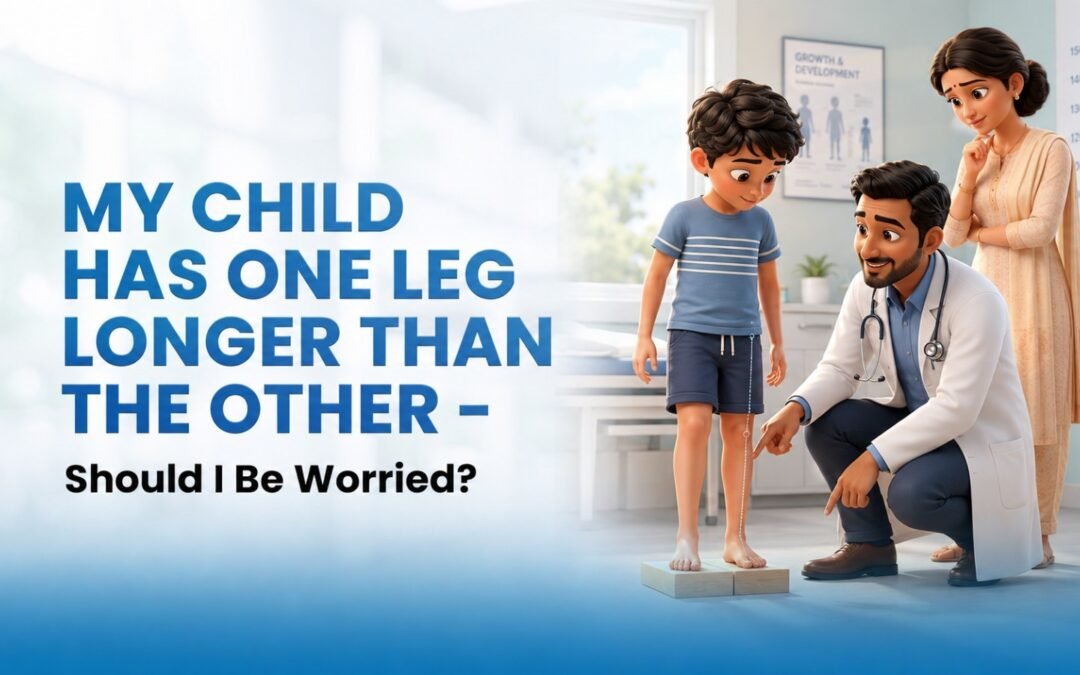
One day, you notice something you cannot quite explain. Your child’s pants seem to sit differently on each leg. One shoe looks more worn out. Maybe your child is walking with a slight limp, standing unevenly, or you simply feel that one leg is longer than the other. Naturally, the next question is: “Is this normal, or should I be worried?”
A leg length difference in children is actually quite common, and a small difference may cause no problems at all. But sometimes, it can be related to the way a child’s bones are growing and may need monitoring by a pediatric orthopedic surgeon.
So, let’s understand what leg length discrepancy in children really means, when it matters, and what parents should do next.
What Is Leg Length Discrepancy?
Leg length discrepancy (LLD) means that one leg is shorter than the other.
Our bodies are not perfectly symmetrical. Small differences between the two legs are common and often do not affect walking, running or playing. Many children with a minor limb length discrepancy may have no symptoms whatsoever.
The concern increases when the difference is larger, increasing with growth, or causing changes in the child’s gait.
Why Is One Leg Longer Than the Other?
There are several possible reasons for unequal leg length in children.
1. It May Have Been Present From Birth
Some children are born with a difference in the development of their thigh bone, shin bone or other parts of the limb. It may be obvious early on, or it may become noticeable only when the child starts standing and walking.
2. Previous Fracture or Injury
A fracture involving a growth plate can sometimes affect the future growth of a bone. In certain situations, the injured bone may grow more slowly or, occasionally, differently from the opposite side.
3. Bone or Joint Infection
Certain childhood bone or joint infections can interfere with normal growth and result in a leg length discrepancy after infection.
4. Developmental or Neurological Conditions
Conditions affecting muscle strength, joints or neurological function can sometimes be associated with differences in limb growth.
And sometimes, despite careful evaluation, there is simply no obvious cause.
How Can You Tell If Your Child Has a Leg Length Difference?
This is where things get interesting.
Sometimes what looks like a shorter leg in a child isn’t actually a difference in bone length.
A tilted pelvis, hip position, foot deformity or another alignment issue can create what doctors call an apparent or functional leg length difference.
That is why measuring your child’s legs at home with a measuring tape isn’t enough.
During a pediatric orthopedic evaluation, the doctor may examine the child’s standing posture, pelvis, hips, knees and feet. Blocks can also be placed under the shorter side to assess whether the pelvis becomes level. If required, imaging can provide a more accurate measurement.
What Signs Should Parents Look For?
A child with a leg length discrepancy may show:
- Limping or an uneven walking pattern
- One hip appearing higher than the other
- Walking on the toes of the shorter leg
- Difficulty running
- Getting tired more easily
- Hip, knee, ankle or back discomfort
- Noticeable difference between the two legs
However, many children with a small difference in leg length have absolutely no symptoms.
Does Leg Length Discrepancy Get Worse as a Child Grows?
Not always – but this is one of the most important reasons to get an accurate assessment.
Children are still growing, so the difference may remain stable, increase or, depending on the cause, change over time. A discrepancy that seems small today may have a different significance as the child approaches their final height.
This is why monitoring leg length discrepancy in children can be more important than simply measuring it once.
The child’s age, cause of the difference, current measurement and expected future growth all matter when deciding whether treatment is necessary.
Final Thoughts
So, should you worry if your child has one leg longer than the other?
Not necessarily.
A small difference can be completely harmless. But because children are growing, the important thing is to understand why the difference exists, how much difference there is, and whether it is likely to change with growth.
If something about your child’s walk or posture doesn’t look right to you, don’t dismiss your observation. Parents are often the first to notice changes in a child’s movement.
Sometimes, the best treatment is reassurance. Sometimes, it is regular monitoring. And sometimes, early intervention can make a significant difference.
When it comes to a growing child, knowing what is normal is just as important as knowing when to seek help.