
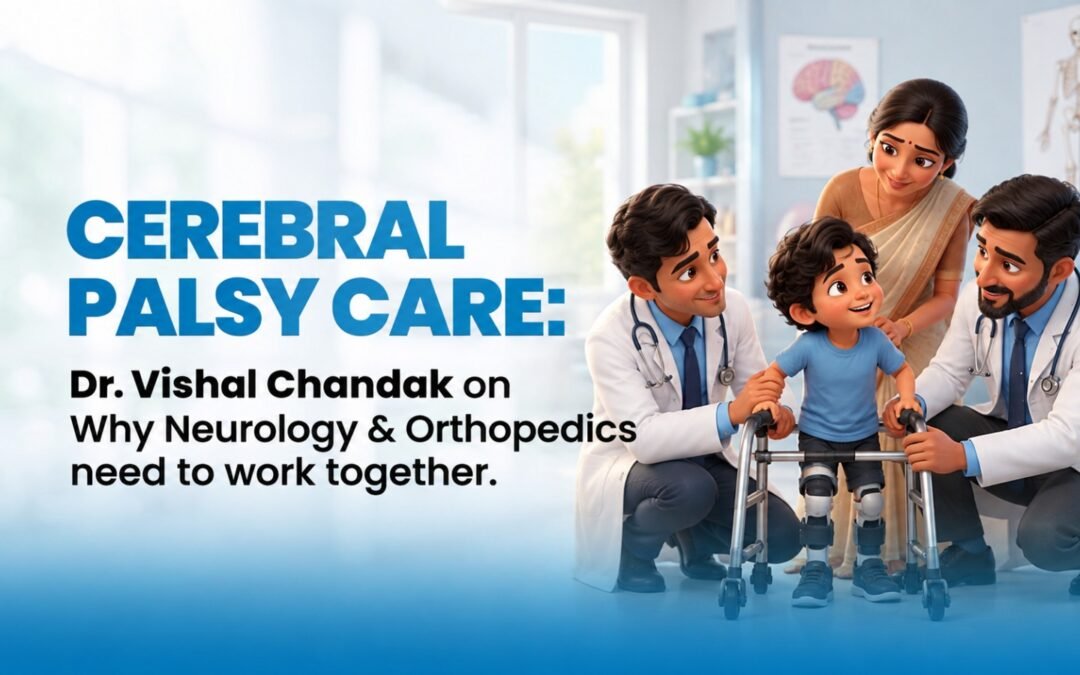
A child with cerebral palsy may have a brain-related condition. So why does orthopaedic care matter?
Because cerebral palsy doesn’t affect only how the brain controls movement. As a child grows, changes in muscle tone, posture, joints, bones and movement patterns can also develop.
That is where neurology and paediatric orthopaedics come together.
What Happens in Cerebral Palsy?
Cerebral palsy (CP) is a group of conditions that affect movement and posture due to disturbances in the developing brain.
Children with CP may experience:
- Muscle stiffness or spasticity
- Abnormal muscle tone
- Difficulty walking
- Balance problems
- Delayed motor development
- Joint stiffness
- Abnormal walking patterns
- Hip or foot problems
The neurological condition may remain the same, but the musculoskeletal effects can change as the child grows.
Why Does Orthopaedic Care Matter?
Imagine a child whose muscles are consistently pulling a joint in an abnormal direction.
Over time, that repeated pull can contribute to tight muscles, reduced joint movement, contractures or changes in bone and joint alignment.
This is why orthopaedic problems in cerebral palsy need to be identified early.
A paediatric orthopaedic specialist may monitor:
- Hip development
- Knee alignment
- Foot and ankle position
- Muscle and joint flexibility
- Walking pattern
- Spinal alignment
- Contractures and deformities
Neurologist + Orthopaedic Surgeon: Different Roles, One Goal
The neurologist focuses on the neurological aspects of cerebral palsy — including muscle tone, seizures when present and overall neurological management.
The pediatric orthopedic surgeon focuses on the growing child’s bones, joints, muscles, gait and musculoskeletal complications.
These roles are different, but they often overlap when planning the child’s care.
Depending on the child’s needs, treatment may include physiotherapy, occupational therapy, orthoses, medications for spasticity, injections or orthopaedic procedures.
Why Regular Follow-Up Matters
One of the biggest mistakes is waiting until a child develops significant pain or difficulty walking.
Some hip, foot or joint changes may develop gradually and may not cause obvious symptoms initially.
Regular assessment can help doctors identify musculoskeletal changes in children with cerebral palsy before they become more difficult to manage.
The Goal Is Not Just “Walking”
Cerebral palsy care is not about forcing every child to walk in the same way.
The goal is to help the child achieve the best possible comfort, mobility, independence and quality of life according to their individual abilities.
That requires coordinated care.
The Bottom Line
Neurology understands the brain and movement control. Orthopaedics manages the growing musculoskeletal system.
For children with cerebral palsy, bringing these perspectives together can help create a more complete approach to long-term care.
If your child has cerebral palsy and you notice changes in walking, posture, joint movement or limb alignment, discuss them with the child’s treating team.