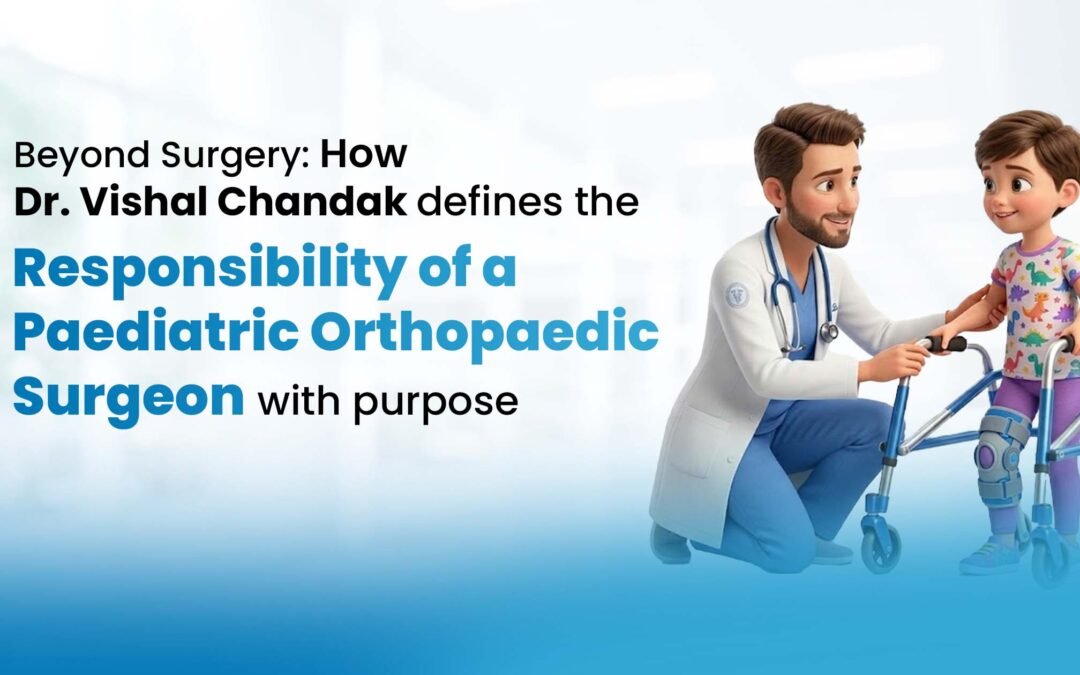
In paediatric orthopaedics, surgery is often seen as the final solution. But according to Dr. Vishal Chandak, surgery is never the starting point — and it is never the only responsibility.
A true paediatric orthopaedic surgeon does more than operate. He guides growth, protects function, and makes decisions that will influence decades of a child’s life.
For Dr. Vishal Chandak, responsibility begins long before the operating room.
Paediatric Orthopaedics Is Not “Miniature Adult Orthopaedics”
Children are not small adults. Their bones grow. Their alignment changes. Their muscles adapt. Their bodies remodel.
This means:
- Treatment decisions must consider future growth
- Timing of intervention is critical
- Overcorrection can be as harmful as delay
- Not every deformity needs immediate surgery
Dr. Chandak believes that understanding growth biology is as important as surgical skill.
The First Responsibility: Clarity Before Action
Parents often arrive anxious, expecting immediate correction.
Instead of rushing toward procedures, Dr. Chandak focuses on:
- Explaining the condition clearly
- Differentiating normal variation from pathology
- Discussing long-term impact
- Outlining all possible options
Sometimes the best decision is observation.
Sometimes it is guided physiotherapy.
And only when necessary — surgery.
Purposeful orthopaedic care begins with judgment.

Surgery as a Strategic Decision, Not an Emotional One
In paediatric fracture management, deformity correction, cerebral palsy care, or clubfoot (CTEV) treatment, timing matters.
Dr. Chandak evaluates:
- Growth plates
- Functional limitations
- Progression risk
- Impact on independence
He often reminds parents that the goal is not perfect X-rays — it is long-term function.
Responsibility Extends Beyond the Operating Table
The work does not end after surgery.
A responsible paediatric orthopaedic surgeon must:
- Plan rehabilitation
- Guide physiotherapy
- Monitor recovery milestones
- Track growth over years
- Prevent recurrence or secondary complications
Post-operative care is not an afterthought — it is part of the treatment design.
Ethical Decision-Making Is Central
In paediatric orthopaedics, unnecessary intervention can alter growth permanently.
Dr. Chandak’s approach is built on:
- Evidence-based protocols
- Conservative judgment
- Transparent communication
- Avoiding overtreatment
- Long-term accountability
Responsibility means saying “not yet” when surgery is premature.
A Future-Focused Perspective
Every decision in childhood affects adulthood.
Dr. Chandak evaluates:
- Will this child walk independently at 20?
- Will joint alignment sustain decades of activity?
- Will muscle balance remain functional long-term?
Paediatric orthopaedic surgery is not about short-term correction — it is about protecting lifelong mobility.
Why Parents Seek Purpose-Driven Care
Parents today are increasingly aware that experience alone is not enough. They seek:
- Structured treatment planning
- Growth-focused evaluation
- Clear risk assessment
- Long-term follow-up strategy
A paediatric orthopaedic surgeon must combine technical expertise with foresight.
Final Thought
According to Dr. Vishal Chandak, the true responsibility of a paediatric orthopaedic surgeon lies beyond surgical skill.
It lies in:
- Protecting childhood growth
- Preserving independence
- Making measured decisions
- Standing accountable for outcomes
Surgery may correct a deformity.
But responsible guidance shapes a future.