
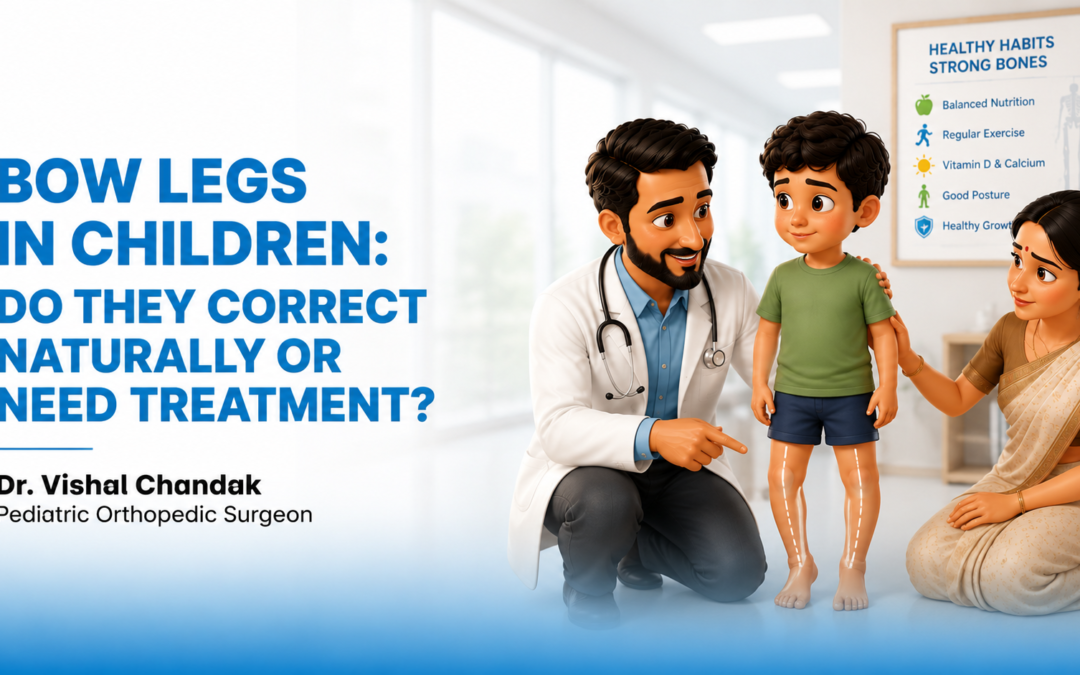
Many parents notice it when their child starts standing or walking.
The legs appear curved outward, creating a noticeable gap between the knees when the ankles are together.
Naturally, questions follow:
“Are my child’s legs normal?”
“Will the bowing improve with age?”
“Does my child need braces or surgery?”
“Could this affect walking or growth later on?”
Bow legs are one of the most common reasons parents seek advice from a pediatric orthopedic surgeon. The good news is that many cases are a normal part of development and improve naturally as a child grows.
However, some children may have underlying conditions that require monitoring or treatment.
Understanding the difference can help parents know when reassurance is enough and when professional evaluation is necessary.
What Are Bow Legs?
Bow legs, medically known as genu varum, occur when a child’s legs curve outward at the knees while the feet and ankles remain closer together.
When a child with bow legs stands with their ankles touching, a gap remains between the knees.
In infants and toddlers, this appearance is often completely normal.
In fact, many babies are born with bowing because of their position inside the womb.
Are Bow Legs Normal in Young Children?
In most cases, yes.
Physiological bowing is considered a normal part of growth and development. A typical pattern of leg alignment is:
- Bow legs during infancy
- Gradual straightening by around 18 to 24 months
- Mild knock knees between 3 and 5 years
- Adult leg alignment by approximately 7 to 8 years
Because of this natural progression, many children with mild bowing do not require any treatment.
Regular observation is often sufficient.
Why Do Bow Legs Occur?
Several factors can contribute to bow legs.
Normal Growth and Development
This is the most common cause. Many infants and toddlers naturally have bowed legs that gradually correct themselves with growth.
Family History
Some children inherit a tendency toward certain leg alignment patterns.
Early Walking
Early walkers may appear to have more noticeable bowing, although this does not necessarily indicate a problem.
Nutritional Deficiencies
Conditions such as Vitamin D deficiency can affect bone development and may contribute to persistent bowing.
Underlying Orthopedic Conditions
In some cases, bow legs may result from specific disorders affecting bone growth. These children require closer evaluation and management.
How Can Parents Tell If Bow Legs Are Normal?
Physiological bow legs generally have several reassuring features.
Children typically:
- Are younger than 2 years
- Have symmetrical bowing in both legs
- Walk normally
- Show gradual improvement over time
- Have no pain
- Grow normally
When these characteristics are present, observation is often appropriate.
Signs That May Indicate a Problem
Not all bow legs are harmless.
Parents should consider medical evaluation if they notice:
Bowing That Worsens Over Time
Normal bowing should gradually improve.
Progressive bowing deserves attention.
One Leg More Curved Than the Other
Significant asymmetry is not typical.
Persistent Bow Legs After Age 2–3 Years
Children whose bowing does not improve with growth may require further assessment.
Limping or Walking Difficulties
Changes in walking pattern should always be evaluated.
Knee Pain
Pain is not usually associated with physiological bowing.
Poor Growth
Short stature or growth concerns may indicate an underlying condition.
Family Concern
If parents feel the bowing is becoming more noticeable, professional assessment can provide reassurance or identify problems early.
Can Vitamin D Deficiency Cause Bow Legs?
Yes.
One important cause of persistent bowing is rickets, a condition resulting from inadequate Vitamin D, calcium, or phosphate.
Rickets affects bone mineralization and may lead to:
- Bowed legs
- Delayed growth
- Bone pain
- Muscle weakness
- Delayed walking
Although less common than physiological bowing, nutritional deficiencies remain an important consideration.
This is one reason pediatric orthopedic specialists often evaluate bone health when bow legs appear unusually severe or persistent.
What Is Blount’s Disease?
Blount’s disease is a growth disorder affecting the upper part of the shin bone (tibia). Unlike normal developmental bowing, Blount’s disease tends to:
- Progress over time
- Affect one leg more than the other
- Cause significant deformity
- Persist beyond the expected age of correction
Early diagnosis can improve treatment outcomes.
How Are Bow Legs Diagnosed?
Diagnosis begins with a detailed medical history and physical examination. A pediatric orthopedic surgeon will assess:
- Age of the child
- Severity of bowing
- Walking pattern
- Growth history
- Family history
- Symmetry of leg alignment
If necessary, additional investigations may include:
X-rays
These help evaluate bone alignment and growth plates.
Blood Tests
Tests may be recommended to assess:
- Vitamin D levels
- Calcium levels
- Other metabolic factors affecting bone health
Many children with physiological bowing do not require extensive testing.
Do Bow Legs Affect Walking?
Most children with normal developmental bowing walk, run, and play without difficulty. They generally participate in physical activities just like their peers.
However, severe bowing or underlying orthopedic conditions may affect:
- Walking mechanics
- Balance
- Physical activity
- Joint loading
This is why ongoing monitoring may be important in certain cases.
Do Bow Legs Correct Naturally?
In many children, yes.
Physiological bow legs often improve naturally as growth continues.
Parents may notice gradual straightening over several months or years. This process requires patience.
Because correction occurs gradually, immediate changes should not be expected. Regular follow-up allows the child’s progress to be monitored appropriately.
The Bottom Line
Bow legs are extremely common during infancy and early childhood.
For many children, they represent a normal stage of development and gradually improve without treatment.
However, persistent, worsening, painful, or asymmetrical bowing should never be ignored.
A timely evaluation by a pediatric orthopedic specialist can determine whether the bowing is part of normal growth or a sign of an underlying condition requiring attention.
Most importantly, parents should remember that not every bowed leg needs treatment—but every concerned parent deserves clear answers and expert guidance.