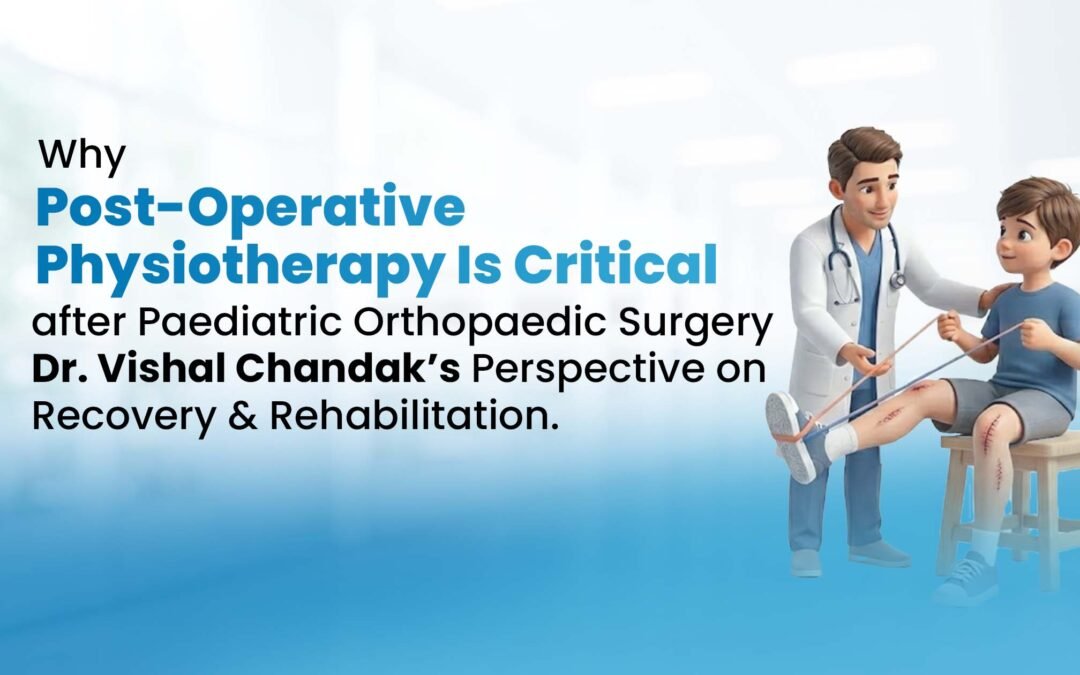
For many parents, paediatric orthopaedic surgery feels like the most important milestone in their child’s treatment. But according to Dr. Vishal Chandak, surgery is only one part of the journey.
The real transformation often happens during post-operative physiotherapy and structured rehabilitation.
In paediatric orthopaedics, recovery is not automatic. It is guided.
Surgery Corrects Structure. Physiotherapy Restores Function.
Orthopaedic surgery may:
- Correct bone alignment
- Release tight tissues
- Stabilise fractures
- Address deformities
But after correction, the body must relearn how to:
- Move efficiently
- Bear weight safely
- Regain muscle strength
- Maintain balance and coordination
Without physiotherapy, the surgical correction may not translate into optimal function.
Why Children Need Structured Rehabilitation
Children adapt quickly — but adaptation without guidance can lead to:
- Improper gait patterns
- Muscle imbalance
- Stiffness
- Delayed recovery
- Risk of recurrence
Dr. Chandak emphasises that early and supervised physiotherapy protects the surgical outcome.
The Critical Phases of Post-Operative Recovery
Recovery after paediatric orthopaedic surgery generally includes:
1️⃣ Early Mobilisation Phase
- Prevent stiffness
- Improve circulation
- Reduce swelling
- Initiate gentle range-of-motion exercises
2️⃣ Strengthening Phase
- Rebuild muscle tone
- Correct compensatory habits
- Restore joint stability
3️⃣ Functional Training Phase
- Gait training
- Balance exercises
- Activity reintroduction
- Return-to-school or sports guidance
Each stage must be personalised based on the child’s age, diagnosis, and surgical procedure.
The Risk of Skipping Physiotherapy
Some parents assume children will “naturally recover” due to young age.
However, skipping structured rehabilitation can result in:
- Reduced range of motion
- Persistent limping
- Delayed muscle strength recovery
- Incomplete functional restoration
Dr. Chandak frequently explains that physiotherapy is not optional — it is part of the treatment protocol.
Rehabilitation in Conditions Like:
Post-operative physiotherapy is especially critical in cases involving:
- Clubfoot (CTEV) correction
- Cerebral palsy surgeries
- Limb deformity correction
- Fracture fixation
- Growth modulation procedures
In these conditions, muscle training and functional retraining are as important as surgical precision.
Collaboration Between Surgeon & Physiotherapist
Successful recovery requires:
- Clear post-op protocols
- Regular monitoring
- Adjustments based on progress
- Open communication with parents
Dr. Chandak works closely with physiotherapy teams to ensure that recovery aligns with long-term growth goals.
The Parent’s Role in Recovery
Rehabilitation does not end at the hospital.
Parents must:
- Ensure consistency in sessions
- Encourage exercises at home
- Avoid overprotection
- Follow weight-bearing instructions carefully
Consistency accelerates confidence.
Recovery Is a Long-Term Vision
In paediatric orthopaedics, the goal is not just healing — it is restoring full independence.
Dr. Chandak evaluates:
- Whether gait is natural
- Whether strength is symmetrical
- Whether mobility supports long-term function
Post-operative physiotherapy ensures that today’s surgery protects tomorrow’s movement.
Final Thought
Paediatric orthopaedic surgery may correct alignment — but physiotherapy builds ability.
According to Dr. Vishal Chandak, true recovery happens when structured rehabilitation transforms correction into confident movement.
Surgery begins the change.
Rehabilitation completes it.