
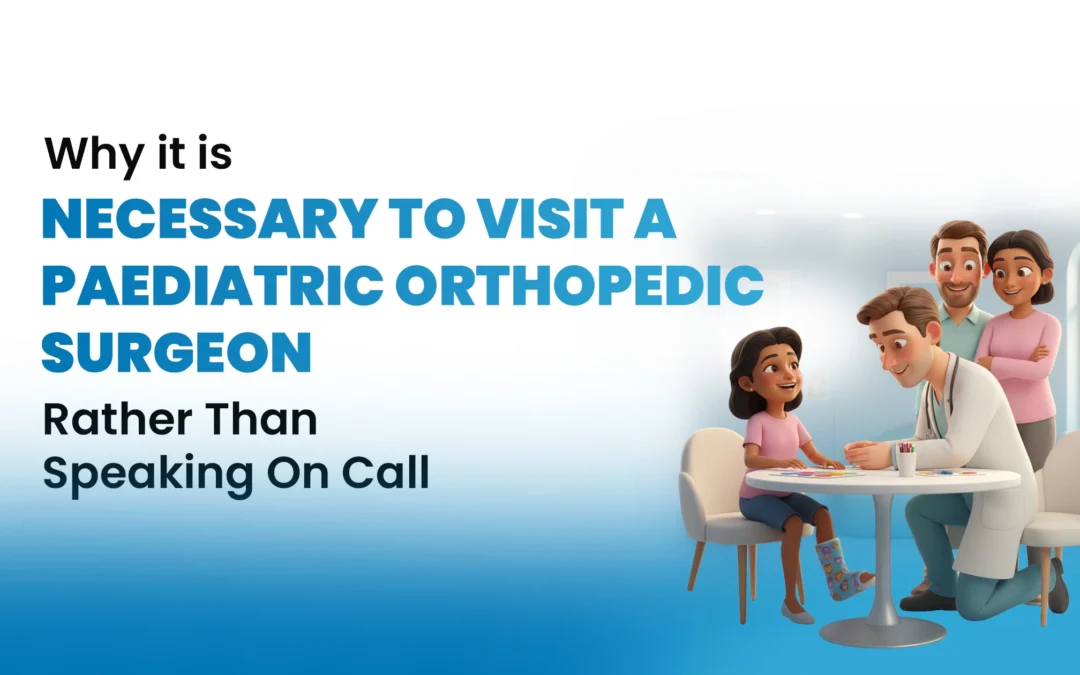
In today’s fast-paced world, parents often look for quick answers. A phone call, a WhatsApp message, or a brief online consultation may seem convenient—especially when a child is in pain or discomfort. However, when it comes to paediatric orthopedic problems, convenience should never replace correctness.
According to Dr. Vishal Chandak, one of the most preferred paediatric orthopedic surgeons in Marathwada, many long-term complications in children arise not because of delayed treatment—but because of incomplete or remote assessment.
Children’s bones are dynamic, growing structures. Treating them requires much more than looking at reports or listening to symptoms over a call.
Children Are Not Small Adults — And Orthopedics Is Visual & Functional
Paediatric orthopedics is not just about pain or X-rays. It is about:
- How a child walks
- How joints move
- How muscles balance each other
- How growth plates are behaving
- How deformities change with growth
These factors cannot be accurately assessed over a phone call or message.
A child who “seems fine” on a call may actually have:
- An early deformity
- A subtle gait abnormality
- A growth plate injury
- Muscle imbalance
- A fracture that is not obvious
Only a physical, in-person examination can reveal these details.

What Gets Missed During Calls or Online Consultations
Parents often share X-rays or videos online and expect a clear answer. While this can offer preliminary guidance, it has serious limitations.
Remote consultations often miss:
- Exact limb alignment
- Joint range of motion
- Muscle tightness or weakness
- Functional limitations
- Pain behaviour during movement
- Growth-related changes
Orthopedic decisions based only on images or descriptions can lead to:
- Incorrect diagnosis
- Over-treatment
- Under-treatment
- Delayed intervention
- Poor long-term outcomes
Why Physical Examination Is Critical in Children
A face-to-face consultation allows the surgeon to:
- Observe how the child stands, walks, sits, and runs
- Compare both limbs carefully
- Assess joint flexibility and stability
- Check muscle tone and strength
- Identify early signs of deformity
- Understand growth patterns
These observations are often more important than X-rays.
In paediatric orthopedics, function always matters more than reports.
The Risk of Over-Reliance on Reports and Online Advice
One common mistake parents make is treating reports as final answers.
For example:
- An X-ray may look alarming, but the child may function normally
- A minor-looking fracture may actually involve a growth plate
- A deformity that looks small today may worsen rapidly with growth
Without in-person evaluation, parents may be falsely reassured—or unnecessarily alarmed.
Why Timing Decisions Cannot Be Made Remotely
Paediatric orthopedic treatment is deeply linked to timing.
Decisions such as:
- When to observe
- When to intervene
- When to operate
- When to wait
depend on:
- Child’s age
- Growth remaining
- Rate of progression
- Functional limitation
These decisions require detailed clinical judgment, not just advice over a call.
When Online Advice Can Be Useful (And When It Cannot)
To be clear, online consultations do have a role.
They can be helpful for:
- Initial guidance
- Follow-up clarifications
- Reviewing progress after treatment
- Answering basic concerns
But they are not a substitute for:
- First-time evaluation
- Surgical decision-making
- Growth-related assessments
- Complex deformity planning
In-person visits are essential at these critical stages.
A Common Scenario Parents Should Be Aware Of
Many parents visit a paediatric orthopedic surgeon only after:
- Trying home remedies
- Consulting non-specialists
- Relying on repeated calls
- Waiting for the child to “outgrow” the problem
By the time they arrive, the condition may have:
- Progressed
- Become more complex
- Required more aggressive treatment
Early in-person evaluation often allows simpler, safer solutions.
Why Parents Across Marathwada Are Choosing In-Person Specialist Care
Over the years, access to specialised paediatric orthopedic care in Marathwada has improved significantly. Parents no longer need to depend solely on remote advice or travel long distances just for proper evaluation.
What makes in-person specialist care valuable is:
- Accurate diagnosis
- Personalised treatment planning
- Growth-focused decisions
- Long-term outcome planning
These cannot be achieved through calls alone.
What Parents Should Remember
Before relying on remote advice, parents should ask themselves:
- Has my child been physically examined by a specialist?
- Has gait and movement been assessed?
- Has growth been considered in the plan?
- Do I fully understand the long-term impact?
If the answer is “no,” an in-person visit is not optional—it is necessary.
Final Thought
Technology has made communication easier, but paediatric orthopedic care still depends on careful examination, observation, and judgement.
Calls can guide. Messages can reassure.
But only a face-to-face consultation can truly protect a child’s growing future.